We are shaping the future of carbon storage by injecting CO2 in basaltic rocks combined with an unique business strategy.
At CREST we aim to store 1 Gt of CO2 per year under the ocean. We help companies decarbonize their valuechain by investing into CO2 storage solution in basalt aquifers. Are you ready to join the carbon storage revolution?

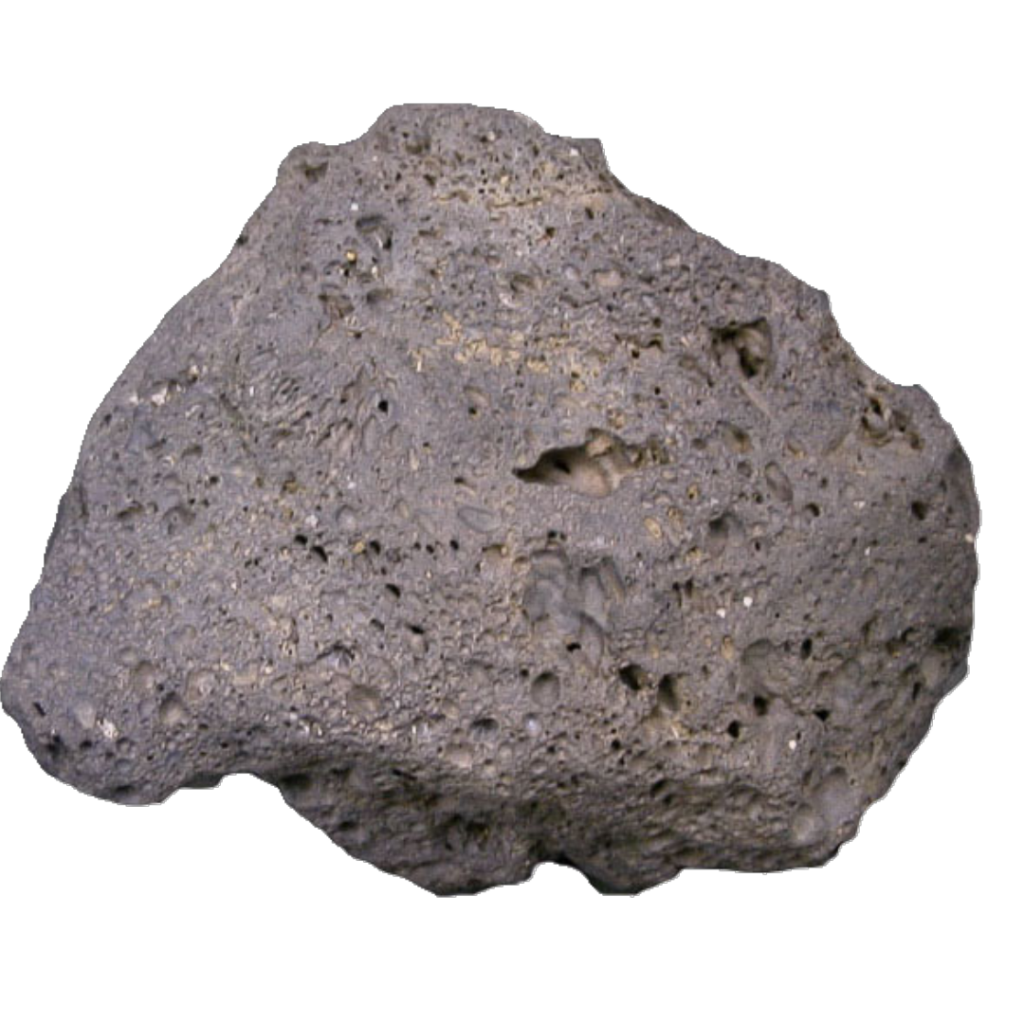
CO2 turns 100x faster into solid rock in basalt aquifers compared to regular saline aquifers or depleted oil and gas fields.
The injection of CO2 in basalts is advantageous due to it’s mineralogical properties. Basalt is made up of mafic minerals such as olivine, pyroxen, amphiboles and biotite. These minerals are rich in Iron, Magnesium and Calcium. When CO2 is injected, it dis-solves in the water relasing H+ ions, which enables the reaction to precipitate stable calcite minerals (Fe, Mg, Ca)CO3 from CO2
Basalt aquifer formations have variable porosity and permeablity properties. In general the tops of the solidified lava flows have the best flow parameters due to porosity created by fractures as a result of the cooling lava. The large volumes of basalt all around the world provide a advantageous solution to store excess CO2 and reach net zero targets.
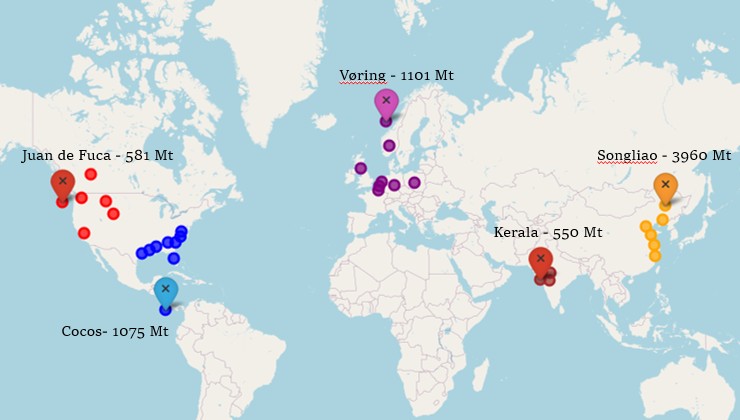
7,5 Gt global CO2 storage
Our global screening service provides an overview of the most advantageous locations to store CO2 in basalt aqui-fers. Our latest analysis shows that a colletive 7,5 Gt can be collected and stored per year.
| Location | Songliao China | Kerala India | Voring Norway | Juan de Fuca | Cocos |
| CO2 storage Mt, minimum | 4000 | 520 | 1100 | 580 | 1070 |
| Porosity (mode) | 7% | 11% | 20% | 20% | 13% |
A new approach to Carbon Markets
The carbon market is a relative new market. In a typical carbon storage project, emitters pay the storage companies to store their CO2. With our innovative approach we directly buy CO2 from emitters and acquier their carbon credits which we can sell. After retrieving our costs and a profit margin we redistribute the income to the emitters.
We specifically target the European market as this market has the most advantageous policies such as a european wide carbon credit system and additional emission tax set by national goverments. Therefore, depending on the country, emitters wil also cut cost spent on carbon tax.
To reduce our initial investment, factories will have to transport CO2 to our centralized hubs located in high emission regions. For small quantities, this can be done by train or ship, for larger quantities, factories will have to invest in a pipeline. This shared investment provides a opportunity for fast rollout.
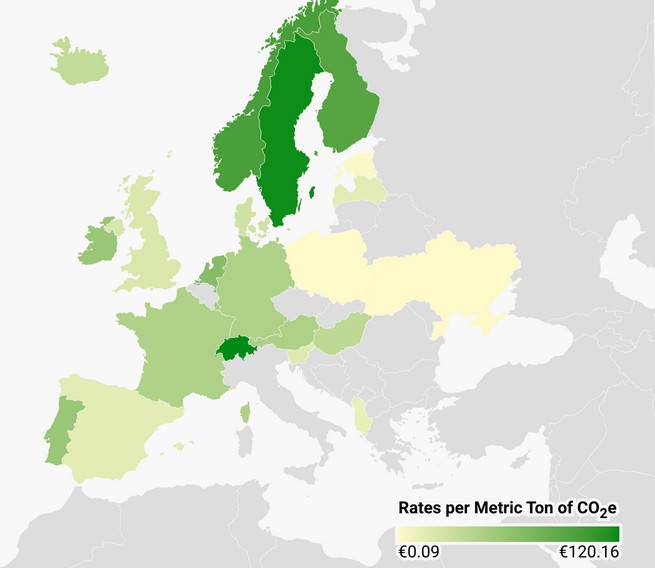
European carbon tax map (Tax Foundation)
The Vøring margin, an ancient lava delta
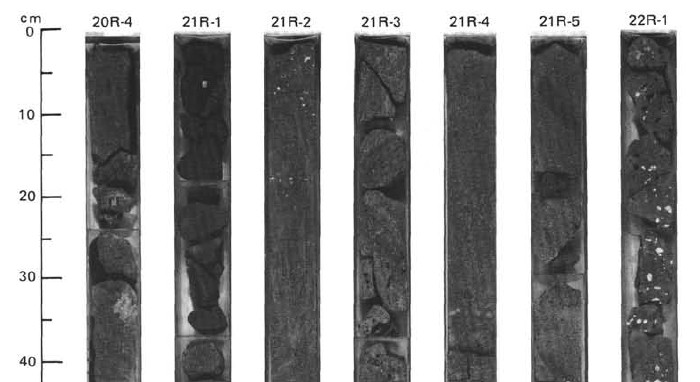
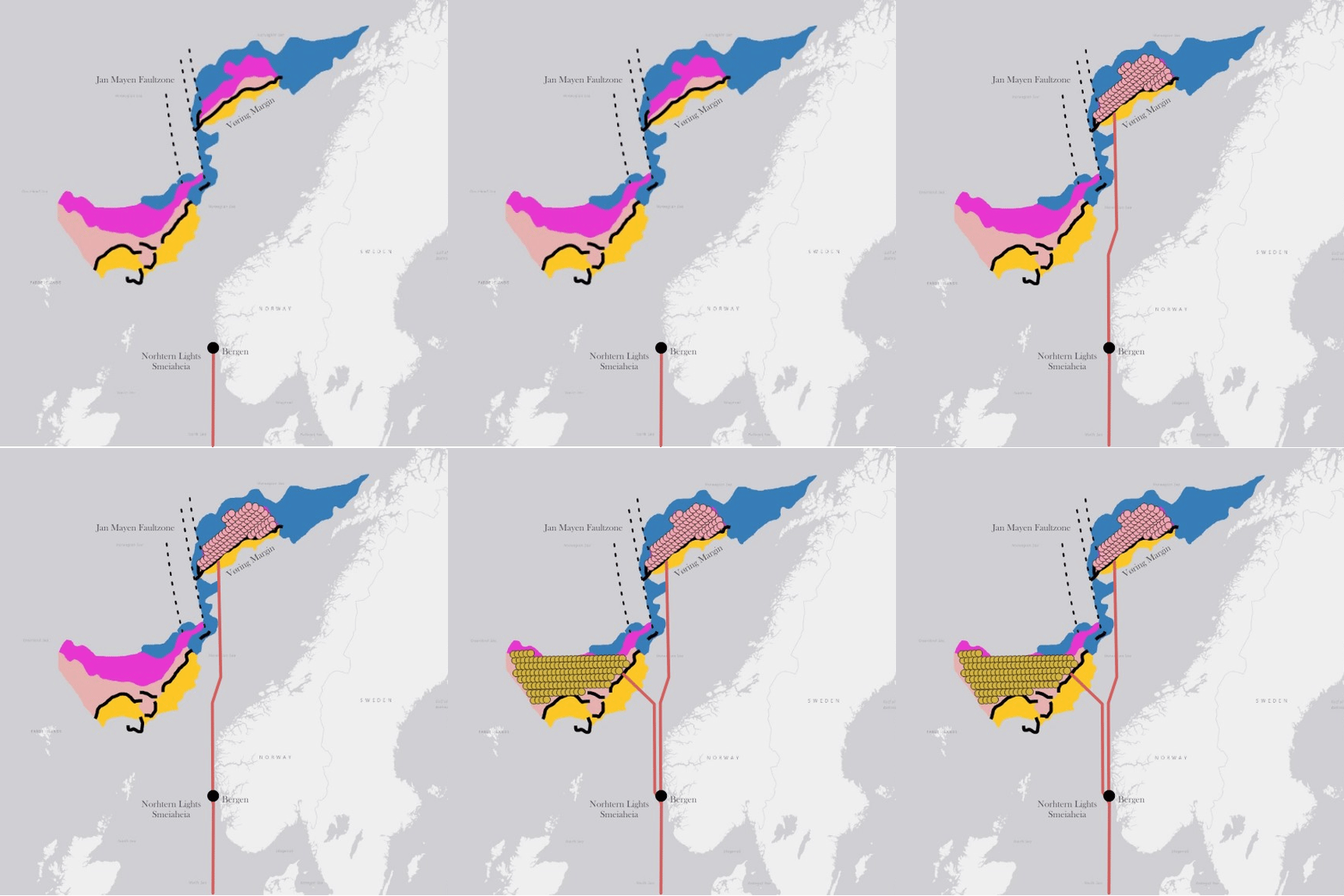
The Voring margin is located around is located around 800 km of the Norwegan coast. Based on seismic interpretation, this late Cretaceous (100 – 66 milion years ago) volcanic province has been interpreted as a volcanic lava delta where basaltic lava flows flowed into the sea [1]. The delta facies has been estimated to be up to 1600 meters thick and is burried below 300 meters of marine shales which provides additional storage integrity. The lava sequence has been drilled and cored in the Ocean Drilling Project, well 642E. These cores have been classified as basalts and andesites [2]. Based on well logs and core analysis, porosity ranges from 10% or less in massive basalts up to 20% to 50% in volcaniclastic layers. The bulk permeability has been estimated at 10-13 m2 providing excellent flow properties in the fractured intervals [3].
The project consist of two phases. Existing surface facilties near Bergen, which are part of the northern lights project, will be upgraded and expanded to treat the CO2 before injection. The CO2 will be transported to pipelines to the injection location. The permeability of the reservoir will be enhanced trough acid injection.
References
[1] Abdelmalak, M. M., Planke, S., Faleide, J. I., Jerram, D. A., Zastrozhnov, D., Eide, S., & Myklebust, R. (2016). The development of volcanic sequences at rifted margins: New insights from the structure and morphology of the Vøring Escarpment, mid‐Norwegian Margin. Journal of Geophysical Research: Solid Earth, 121(7), 5212-5236.
[2] Eldholm, O., Thiede, J. Taylor, E., et al., 1987. Proc, Init. Repts. (Pt. A), ODP, 104.
[3] Harris, R. N., & Higgins, S. M. (2008). A permeability estimate in 56 Ma crust at ODP Hole 642E, Vøring plateau Norwegian Sea. Earth and Planetary Science Letters, 267(1-2), 378-385.
Rock composition
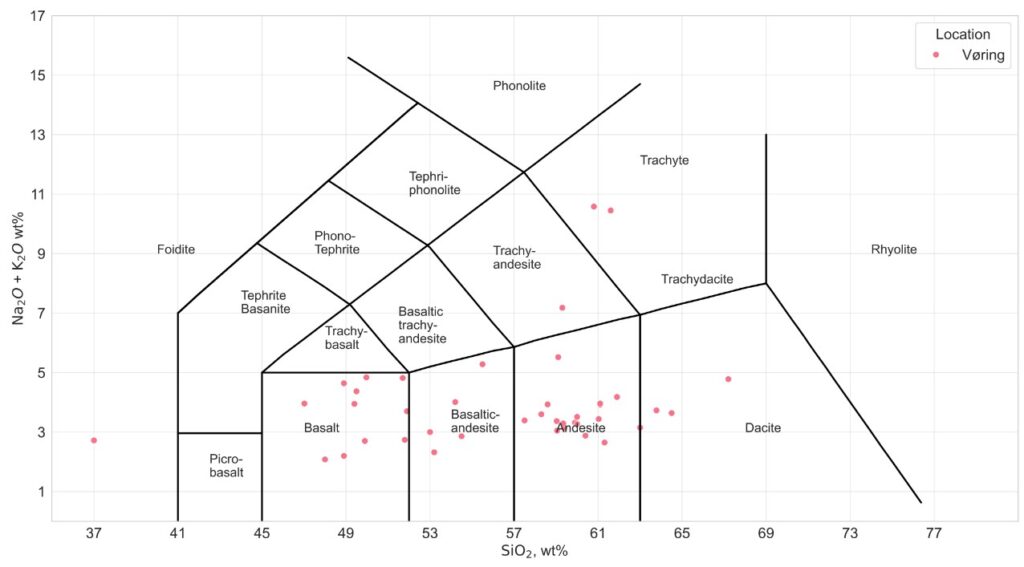
TAS diagram of ODP hole 642E core samples.
We use model driven predictions to asses what happens in the subsurface during and after CO2 injection
We use our advanced models to assess the feasibility of supercritical CO₂ injection. Advanced reservoir engineering techniques combining non-Darcy radial gas flow with pseudo-pressure and MDH-based pressure buildup analyses help us determine key parameters such as the injectivity index, storable CO₂ volume, and the number of wells required. The P50 scenario yields an injectivity index of 9.55 tonnes CO₂·cp/bar²·year. Therefore 220 wells are needed to reach an annual injection rate of 1 Gt and a storage capacity of approximately 5.31 × 10¹⁰ tonnes CO₂. We also use state of the art reactive transport simulations to examine geochemical interactions, as visible on the graph there will be significant mineralizaiton. Our simulations predict that progressive dissolution of formation minerals and the subsequent precipitation of carbonate minerals (predominantly dolomite and calcite) result in 4.6 Gt mineralized CO₂.
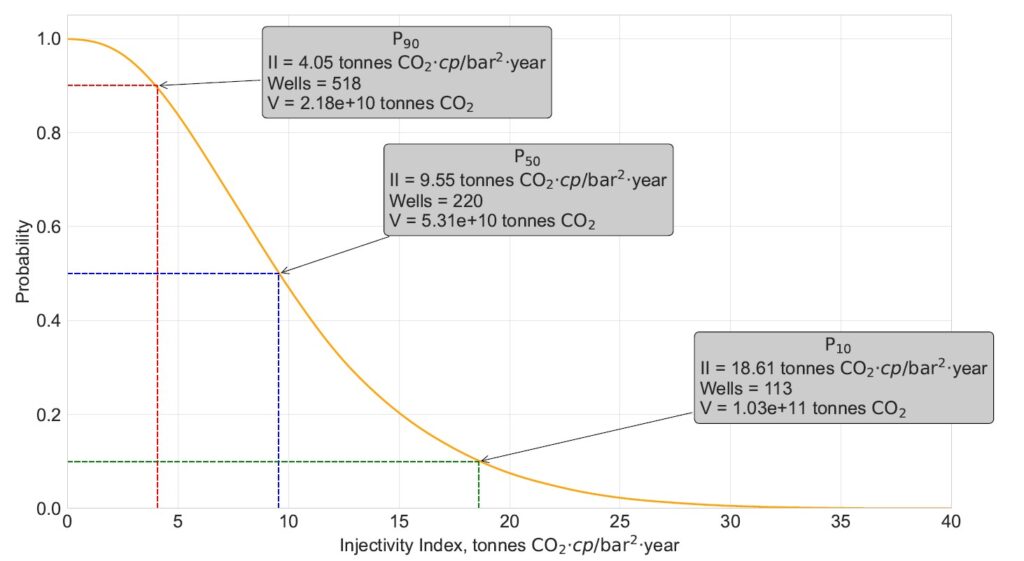
probability distribution for total storage capacity
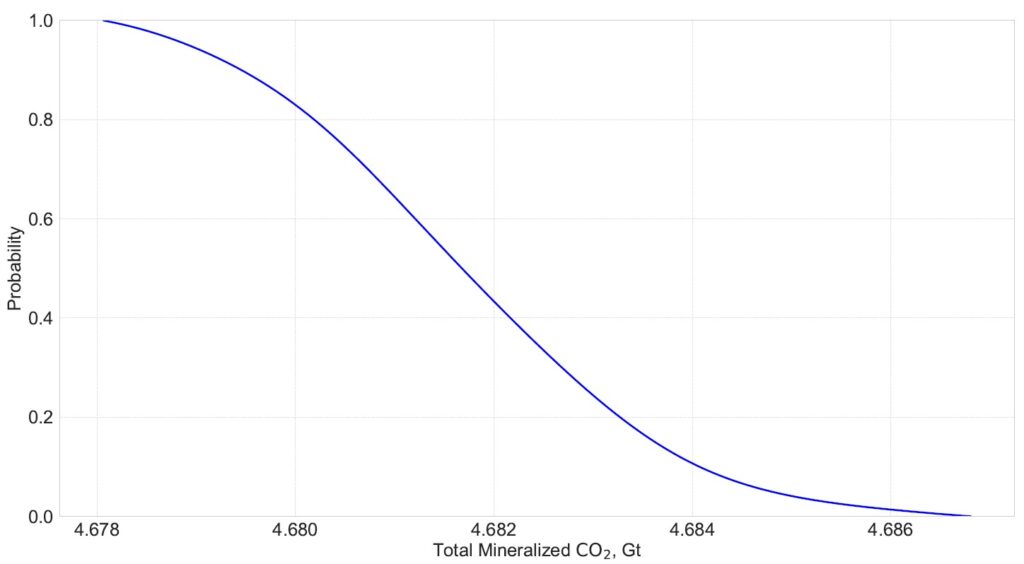
probability distribution for total mineralization volume
Investor Information
Together with our key partners we developed an economic model based on a unique business approach, where we acquire CO₂ from emitters in return for allowances reflecting their relative contributions. Decline-curve cost projections over a 25-year period (Eq. 1), showed in the figure, indicate that the project is expected to breakeven at 25 years under base case conditions, or at 22 years in a best-case scenario. However, the worst-case scenario does not achieve breakeven within the same timeframe.

Formula key
Ct : Cost in year t, €/ton CO2
Co : Initial cost, €/ton CO2
Qt : Cumulative CO2 stored by year t, Gt
Qo : Initial cumulative capacity, Gt
b : Decline rate coefficient
LR: Learning rate

Cashflow
Meet the team
Our team is comited to deliverer value to your CO2 storage project. Born in France at the IFP school, CREST is now helping numerous companies around the world to cut their emissions and create a longterm vision to reach net zero.

Berat Günel
Founder, CEO & Petroleum Engineer

Jonathan Chin
Geologist and basin analyst

Ahmed Mokhtar
Petroleum Engineer

Mahmoud Mohammed
Petroleum Engineer

Shahana Mammadova
Geophysicist